
Take a minute to think about your time in education. For most people in the UK this time lasts at least 12 years, almost 2 decades for a postgraduate student. In an age of rapid technological advances, a lot can change in this seemly short period of time- fast forward to today and I am learning a University module through an online MOOC course and engaging with my educator using my own digital blog.
The digital economy is a concept that takes into account the shift in big data, online platforms, and hyper-connectivity (Deloitte 2020). Nicholas Agar (2017) discussed how many job roles seem ‘eminently and imminently’ replaceable in this economy, the question is could a career in teaching fall victim to this threat too or will there always be needs within learning that only human interaction can fulfil?
The role a teacher plays in learning has changed substantially already in the digital economy, with various examples outlined below.
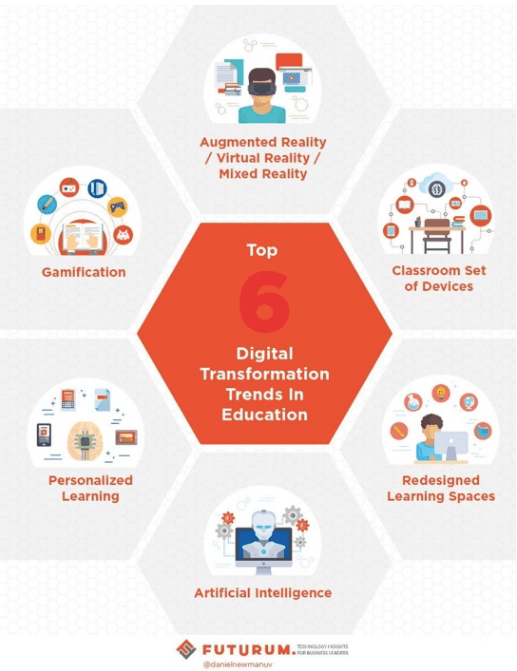
Although all of these trends are becoming increasingly relevant in a digital age, redesigned learning spaces are a transformation that have sparked considerable debate in the extent to which the teachers in the future will become increasingly obsolete.
On the most part, if there is a skill or topic you want to learn you can usually find a suitable course or app online to achieve this. I am attempting to learn a new language and have re-downloaded an app that I was first introduced to by my teacher to use alongside revision for GCSE’s. This is an example of how digital developments have worked in harmony with formal educators. John Swinney, the Cabinet Secretary of Education in Scotland, discussed the importance of this harmony in enriching the learning experience and supporting teaching (Smarter Scotland, 2016). He also added a valuable point of, especially in today’s age, the importance of familiarity and understanding of the digital world in setting students up for the future.
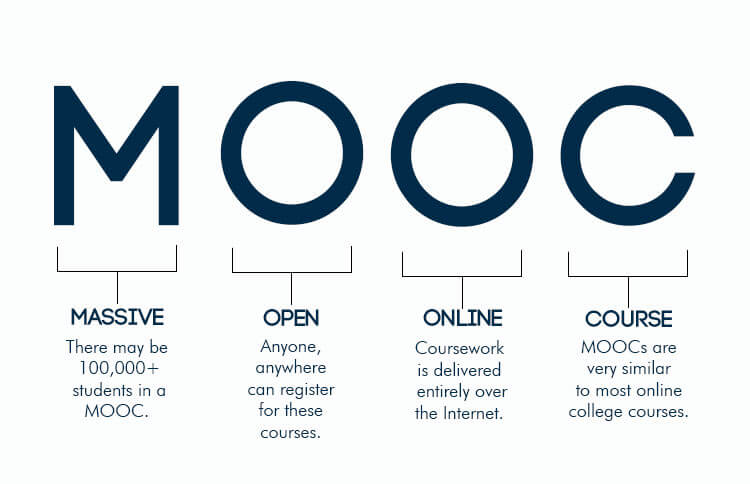
For education at degree level, over 80 Universities similar to Exeter have partnered up with Massive Open Online Courses (MOOCs) on the platform ‘Future learn’ to provide students with an independent and accessible way to enhance their learning either for short courses or entire degrees. The use of MOOCs remove the role of face-to-face teaching and instead offer students the ability to peer assess and interact with educators online through quizzes and comments (Belleflamme and Jacqmin, 2016).
On a more extreme scale, establishments like the ‘Open University’ (OU) have further disrupted the role of the traditional educator by offering learners a digital distance University experience off campus. With over 2 million students, the OU is the largest University in the UK and a leader for flexibility and innovation. Even primary and secondary educators are facing change with the popularity of a similar platform ‘InterHigh’ which offers interactive online ‘classrooms’ for children as young as 8. The interest in these platforms highlights future power to further challenge traditional classroom teaching.
I question whether traditional teaching methods in formal education will ever change completely. Pappano (2012) claimed that the future of education would be dominated by digital learning and MOOC platforms, as its interactive and collaborative nature provides an experience beyond the classroom. But are these redesigned learning spaces really a threat to traditional careers in formal education? An article by the Guardian (2018) shone a light on the downfalls of the Open University and the failures of its ‘depersonalised’ approach in acutally achieving successful graduation rates compared to institutions using more traditional direct approaches.
With this in mind, take some time to watch and consider the ideas discussed in this TedxTalk on the positive influence of MOOCs in the higher education University system.
‘There is no one size fits all for teaching and learning’. This suggestion in the talk offers a new way of thinking for the changing role of educators in the digital economy. It is not necessarily a question of the digital world replacing the traditional one, but simply that MOOCs are offering the opportunity for a new form of teaching that Universities should be supporting alongside face-to-face methods. A continued collaboration between traditional and digital learning may be a more appropriate projection for the future of teaching
So what does the future hold? The role a teacher holds in education will continue to adapt and be enhanced by digital learning spaces, especially in higher education. There is no doubt that as we move forward digital and traditional teaching will develop to work together to enhance the learning experience using platforms like MOOC and online communities. My answer to whether these platforms will dominate the career role is that it is unlikely due to the fundamental need for many students, myself included, for the structure and stability that only human guidance can offer.
Sources:
- Agar, N. (2019). How to be human in the digital economy (p. 4). Cambridge, Mass: The MIT Press.
- Belleflamme, P., & Jacqmin, J. (2015). An Economic Appraisal of MOOC Platforms: Business Models and Impacts on Higher Education. Cesifo Economic Studies, 62(1), 148-169.
- Deloitte. (2020). What is digital economy? | Deloitte Malta | Technology. Retrieved 9 February 2020, from https://www2.deloitte.com/mt/en/pages/technology/articles/mt-what-is-digital-economy.html
- Pappano, L. (2012). The Year of the MOOC. Retrieved 10 February 2020, from https://www.nytimes.com/2012/11/04/education/edlife/massive-open-online-courses-are-multiplying-at-a-rapid-pace.html
- Smarter Scotland. (2016). Enhancing learning and teaching through the use of digital technology (p. 1). Edinburgh: Smarter Scotland. Retrieved from https://www.gov.scot/binaries/content/documents/govscot/publications/strategy-plan/2016/09/enhancing-learning-teaching-through-use-digital-technology/documents/00505855-pdf/00505855-pdf/govscot%3Adocument/00505855.pdf
- The Guardian. (2018). Worries grow about the survival of the Open University | Letters. Retrieved 9 February 2020, from https://www.theguardian.com/education/2018/mar/25/worries-grow-about-the-survival-of-the-open-university
 The Digital Exchange
Hi Digital Exchange!
First off, a really interesting and topical read. I fully agree with your point in suggesting that although technology is playing an increasingly vital part of our learning environment, teachers will continue to provide structure, motivation and compassion during the learning process. Although, I have never personally considered applying for the Open University, mainly because of the lack of face-to-face interaction between student and teacher, that’s not to say that I don´t find the idea of learning with the use of digital platforms worthwhile and revolutionary.
Especially, as non-English speaker being able to take flexible and tailored online English courses e.g. Udemy have been extremely helpful in achieving my educational goals. Mainly because of this I do agree with your statement in saying that the 21st century learning environment will not be dominated by one factor, instead a combination of educators teaching with the compliments of technology.
LikeLiked by 1 person
Hi O!sodigital!
Thank you for your comment, I agree with you that the Open University is a revolutionary platform for learning, especially for people who would benefit from distance learning, but like yourself I never considered it as I too would struggle with the lack of face-to-face interaction. I agree that online courses can be flexible and helpful, I have used futurelearn in the past to complete an online course in Psychology before I started my undergraduate degree. Thank you for sharing your experience with digital learning.
LikeLiked by 1 person
Hi Laura!
I found this to be very interesting and I particularly like how participating in the MOOC in our Digital Business Models module inspired you to explore how the role of teachers (and education in general) is being impacted by the digital economy.
I think that it was extremely important that you differentiated between the different levels of impact that technology will have on primary and secondary teaching vs higher education, you explained this in a very clear and succinct way. Upon further exploring this topic, I was shocked that research conducted by the ONS concluded that the role of higher education teaching professionals has a likelihood of 20.27% of being automated whilst primary teachers are at 22.03% and secondary 20.61%. I would not have assumed this as from personal experience I would argue that students in primary and secondary education need more structure and stability provided by physically going to a school than those in higher education.
However, academics at MIT found that they had a 96% dropout rate for MOOCs on their platform edX so perhaps this is not the case and all levels of education need human interaction and accountability. Studying online is clearly impacted by a lack of motivation. I am intrigued to know whether you think websites such as InterHigh will face such problems with their learners and how you think they could tackle these potential pitfalls?
Office for National Statistics (ONS). (2019). The probability of automation in England: 2011 and 2017 [Datagraphic]. Retrieved from https://www.ons.gov.uk/employmentandlabourmarket/peopleinwork/employmentandemployeetypes/articles/whichoccupationsareathighestriskofbeingautomated/2019-03-25
Reich, J., & Ruipérez-Valiente, José A. (2019). The MOOC pivot. Science, 363(6423), 130-131. doi: 10.1126/science.aav7958
LikeLiked by 1 person
Hi Steven,
Thank you for your comment and research! I am also surprised by the ONS statistics as similar to what was discussed in my post, I would expect human support to be most vital in the formative years of learning. The MIT findings surprise me less as similar to the poor graduation rates of the Open University, I agree that digital learning does rely more on independent motivation with less accountability. To answer your question I would expect sights such as InterHigh to struggle less with this issue as the students are younger and learning compulsory curriculim as opposed to voluntarily choosing to complete a course. Also the website provides support to guardians to encourage their children to complete the work, similar to traditional primary and secondary education.
LikeLike
Hi Laura!
Thanks for this very interesting article! I also believe that online classes are probably going to change the traditional teaching role even more in the future. I actually tried a few MOOCs to develop additional skills and I really enjoyed it! I believe however that while they can supplement traditional teaching methods, they cannot fully replace them.
That’s why I’m a bit skeptical about the « Open University » concept, at least for initial training. Besides the importance of face-to-face interactions with a teacher to learn and stay motivated, I think that university is also a human experience; that’s where we meet friends, develop new interests through sports and societies … and these are part of the learning process as well. But maybe it is a good opportunity for professionals to start university again without moving on campus or maybe quitting their jobs. What do you think?
LikeLiked by 1 person
Hi Nolwenn,
I completely agree that a hugely important aspect of university is learning through human experience outside of the ‘classroom’, thank you for sharing! I also strongly concur that platforms like the Open University do offer some individuals a flexible opportunity to gain qualifications through distance learning and provides teaching that is most suited to them. This is another example of how the concept that ‘there is no one size that fits all’ is very relevant in today’s society.
LikeLike
A very pertinent choice of topic and an interesting read. I am in agreement with you that the future of education does not necessarily lie within any one route such as going fully digital or remaining fully traditional. The future of education likely resides within a combination of the two with the interpersonal interactions and guidance of a human teacher being complemented by the use of digital platforms. This is exemplified by services such as mytutor.co.uk which enables a human tutor to interact with students around the world via online video chat services whilst also providing access to numerous digital provisions such as archived past papers and electronic textbooks. Ultimately, whilst digital learning platforms are great at providing wider access to a range of materials, a human teacher will likely always remain relevant in order to aid a pupil in the proper engagement of said materials.
LikeLiked by 1 person
Hi Laura, I found this a really interesting blog, particularly as it is very relatable. I completely agree with you that there is a need for digital technology and traditional methods to work together in harmony for optimal teaching. Digital technology can certainly improve the teaching experience in many ways and as suggested by Nolwenn may be particularly useful in allowing adult learners to educate themselves without the need to relocate. I also agree with the comments you have mentioned from John Swinney, and feel it is imperative that children are given the best tools to succeed in the future, one of these tools being an understanding of a digital world.
However, I can certainly see a number of key drawbacks in digital technology replacing certain areas of traditional teaching. For example, I believe that interaction between students is highly important to the learning process and wonder if these interactions can be achieved through digital systems as effectively. Whilst the accessibility of sites such as MOOC world-wide means there is greater chance to interact with more people, I worry that they are very dependent on people using them respectfully, as often people are very confrontational when hidden behind a keyboard in a way that they are not in face-to-face conversations. Given that MOOCs remove face-to-face interaction in place of interaction online through quizzes and comments, I think it is important that site hosts carefully monitor comments in order to ensure students feel able to share ideas in a positive environment (Belleflamme and Jacqmin, 2016).
As Steven has suggested in his comment, I believe that all levels of education require a certain level of human interaction and accountability and therefore I agree with your blog that a collaboration between digital and traditional teaching methods may be the most effective way forward in the future.
LikeLiked by 1 person
Thank you for your comment! I didn’t consider the risk of confrontation between users on platforms like MOOC, it is true that this would have to be taken seriously as bullying and negative comments online are an important and growing issue on digital spaces.
LikeLike